The Generative Edge: How Flow, Finitude, and Forecasting Converge at Life's Most Productive Frontier
A synthesis of complex systems, consciousness, and the art of committed attention
📥 Download Cover Image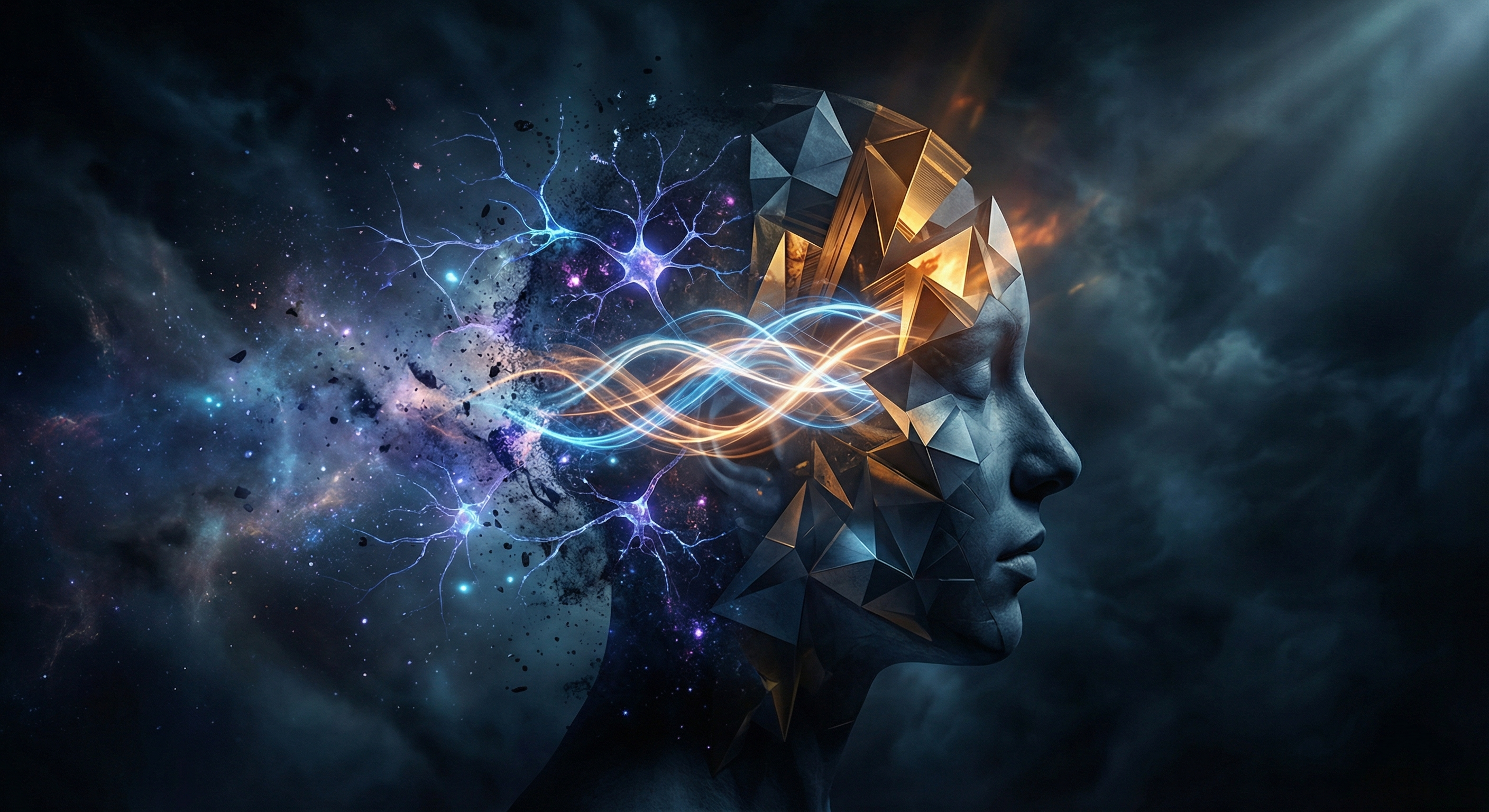
---
The Pattern Beneath the Surface
Something curious happens when you examine the notes scattered across domains as disparate as artificial intelligence, meditation, economics, and romantic relationships. A pattern emerges that none of these fields explicitly claims, yet all of them describe from different angles. It is the pattern of the generative edge—that narrow band where order and chaos meet, where constraint paradoxically creates freedom, and where the most alive, creative, and fulfilling experiences occur.
This essay traces the hidden connections between flow states, complex adaptive systems, Bayesian cognition, and human finitude. The argument is simple but counterintuitive: the conditions that allow neural networks to learn, ecosystems to evolve, economies to innovate, and humans to experience deep fulfillment are structurally identical. Understanding this pattern offers not just intellectual satisfaction but practical guidance for how to live, work, and relate.
---
The Edge of Chaos: Where Life Actually Happens
Complex adaptive systems—whether markets, cells, ant colonies, or human societies—exhibit a peculiar property. They do not thrive in perfect order, nor do they survive in complete chaos. They require a specific balance point that complexity researchers call the "edge of chaos."
At this edge, the components of a system never quite lock into rigid structure, yet never dissolve into turbulence either. The economy self-organizes through millions of individual transactions without central planning. Genes in an embryo coordinate to form a liver cell or a muscle cell without a blueprint. Birds adapt to their neighbors and form flocks without a leader. Evolution itself operates here, constantly tuning the boundary between stability and adaptation.
What makes this edge so special? It is the only place where information can be both preserved and transformed. Too much order, and nothing changes; the system stagnates. Too much chaos, and nothing persists; the system disintegrates. At the edge, patterns can form, evolve, and dissolve in response to changing conditions. This is where innovation happens. This is where life happens.
The insight that should arrest us: human consciousness appears to operate on the same principle.
---
Flow as the Subjective Experience of the Edge
Mihaly Csikszentmihalyi's research on flow states describes a condition where "your sense of time, place, and self melts away." Flow occurs when a person is fully absorbed in a meaningful challenge, stretched to their limits in a voluntary effort to accomplish something difficult and worthwhile. The best moments of human experience, Csikszentmihalyi found, are not passive pleasures but these moments of total involvement.
Consider the structural similarity. Flow requires a balance between skill and challenge—too easy, and boredom results; too hard, and anxiety overwhelms. The flow channel is narrow. It demands what the complex systems literature would recognize as the edge of chaos: enough stability to maintain coherence, enough challenge to require adaptation.
But here is a deeper connection that the literature rarely makes explicit: flow states are what it feels like to operate at the edge of chaos in your own nervous system.
When you are in flow, your brain is not executing a pre-programmed routine. It is generating predictions, testing them against reality, and updating its models in real time. The activity is demanding enough to require full engagement but structured enough to allow progress. You are neither stuck in rigid habit nor overwhelmed by randomness. You are at the generative edge.
---
The Bayesian Brain: Predictions, Errors, and Dreams
The Bayesian brain hypothesis offers a mechanistic explanation for why the edge of chaos feels like flow. According to this framework, the brain operates as a prediction machine, constantly generating hypotheses about what sensory inputs it will receive and updating those hypotheses based on prediction errors—the difference between expected and actual experience.
Perception, on this view, is not passive reception of information but active construction. We do not see the world as it is; we see our brain's best guess about what the world contains, informed by priors and corrected by sensory data. The philosopher's observation that "if hallucination is uncontrolled perception, maybe perception is controlled hallucination" captures this precisely. We are hallucinating all the time, but when our collective hallucinations align, we call that reality.
This brings us to dreams. The notes suggest that dreams serve a semi-computational function: "improving your generative model and tuning it up—pushing back against the daily overfitting." This is a striking insight. Overfitting, in machine learning, occurs when a model becomes too specialized to its training data and loses the ability to generalize. The brain faces the same risk: too much focus on the specific patterns of daily life, and we lose cognitive flexibility.
Dreams, with their surreal recombinations and symbolic narratives, may function as a regularization technique. They inject noise into the system. They force the brain to explore regions of possibility space that waking experience never visits. In other words, dreams push the brain toward the edge of chaos to prevent it from crystallizing into rigid, maladaptive patterns.
The implications are profound. Sleep is not merely rest; it is maintenance of the brain's capacity to learn. The wandering mind of the dream state is not a bug but a feature, keeping the predictive machinery flexible and adaptive.
---
Finitude as a Feature, Not a Bug
Modern productivity culture treats constraints as obstacles to overcome. There is always a new hack, a new system, a new app promising to help you fit more in. But the notes offer a radical counterargument: "The more you confront the fact of finitude, the more productive, meaningful, and joyful life becomes. The more you try to manage your time to get the feeling of achieving total control, the more stressful, empty, and frustrating it gets."
This is not mere stoicism. It is systems thinking applied to human experience.
Attention is zero-sum. You cannot commit to everything. The belief that you can fit everything in leads not to fulfillment but to its opposite—languishing, that gray zone between flourishing and depression where you are busy but not engaged, active but not alive. Finitude is not a problem to solve but a structural feature of existence that creates the conditions for depth.
Consider the parallel to complex systems again. An economy without scarcity would have no prices, no information, no innovation. Scarcity forces choices, and choices generate information about preferences. Similarly, the finitude of human attention forces commitment, and commitment generates the conditions for flow.
The notes capture this elegantly: "Commitment happens in stages, and only then can you stop hugging the X axis." The X-axis represents optionality—keeping all possibilities open, never choosing, forever browsing. The hockey curve of growth only begins when you commit, when you accept the sacrifice of alternatives that finite time demands.
---
Connection, Vulnerability, and the Architecture of Trust
If flow is the individual experience of the generative edge, relationships are its social manifestation. The notes state baldly: "Conversation is the relationship." This is not metaphor. It is a structural claim about how human systems self-organize.
Relationships, like economies and ecosystems, are complex adaptive systems. They do not exist in any single individual but in the patterns of interaction between individuals. And like other complex systems, they require a specific balance to thrive—enough stability for trust to form, enough novelty for growth to continue.
The critical condition for relational depth is vulnerability. "In order for connection to happen, we have to allow ourselves to be really seen." This is the interpersonal equivalent of the edge of chaos. Too much guardedness, and the relationship stagnates into polite performance. Too much exposure without safety, and the relationship dissolves into anxiety or rupture.
The depth of connection, not the frequency of communication, determines relationship quality. This mirrors the finding about flow: it is not the quantity of time that matters but the quality of engagement. Relationships, like consciousness itself, require the generative edge—enough predictability for security, enough risk for growth.
---
The Blind Spot: Why We Resist the Edge
If the edge of chaos is where life happens, why do we spend so much effort avoiding it?
The answer lies in a mismatch between our evolved preferences and the demands of modern existence. We are drawn to certainty because uncertainty historically correlated with danger. We crave control because helplessness correlated with death. We seek to preserve options because commitment historically risked exploitation.
But the modern world has inverted many of these correlations. The greatest danger is no longer the predator in the bush but the stagnation of a life without challenge. The greatest loss is not the resources expended on a failed venture but the years spent in languishing, never committing, never risking, never really living.
We resist the edge because it feels like anxiety. But the notes distinguish carefully between anxiety and the willingness to feel anxiety: "What is important is the willingness to feel the anxiety induced by finitude without trying to fit everything in." The feeling is unavoidable. The response is chosen.
---
Toward a Practice of the Generative Edge
What would it mean to live at the edge of chaos deliberately?
In work: Pursue challenges that stretch your abilities without overwhelming them. Embrace the discomfort of not knowing yet. Recognize that flow is not a lucky accident but a predictable result of matching skill to challenge—and that both must be continuously upgraded.
In rest: Honor sleep and dreams not as passive downtime but as active maintenance of cognitive flexibility. The wandering mind, the daydream, the unstructured time—these are not inefficiencies to eliminate but regularization techniques that prevent overfitting to the narrow patterns of productive work.
In relationships: Practice vulnerability as a skill, not a trait. Commit in stages, testing the waters, then diving deeper. Recognize that the fear of shame is the biggest barrier to connection, and that the willingness to be seen is the price of being known.
In life design: Confront finitude directly. The 4,000 weeks are not a problem to optimize but a frame that makes choice meaningful. Every commitment is a sacrifice, and that is precisely what makes it significant. You cannot fit everything in, and that is good news—it means you can fit the important things in.
---
The Synthesis
The threads converge on a single insight: life, consciousness, and creativity all require the same structural conditions. They need enough order to maintain coherence, enough chaos to enable adaptation, and the willingness to remain in the tension between the two rather than fleeing to either pole.
The edge of chaos is not a comfortable place. It is not meant to be. Comfort is the province of stagnation. The edge is where you are stretched, where you are uncertain, where you are, in a word, alive.
The complex system does not fear its own evolution. The river does not lament its flow. And perhaps we, who are both the observers and the observed, the predictors and the predicted, can learn to embrace the generative edge not as a problem to solve but as the very condition of our existence.
The choice is always there: hug the X-axis of optionality, forever browsing, never becoming. Or commit, sacrifice, and in that very act of limitation, discover the strange and paradoxical freedom that only finitude can provide.
Life happens at the edge of chaos. Your move.
---
Generated: February 11, 2026
Sources: Obsidian Vault notes on flow, complex adaptive systems, Bayesian brain, finitude, commitment, vulnerability, and well-being.