The Mycelial Mind: What Fungi, Flow States, and Artificial Intelligence Teach Us About Connection
Wednesday, February 18, 2026
📥 Download Cover Image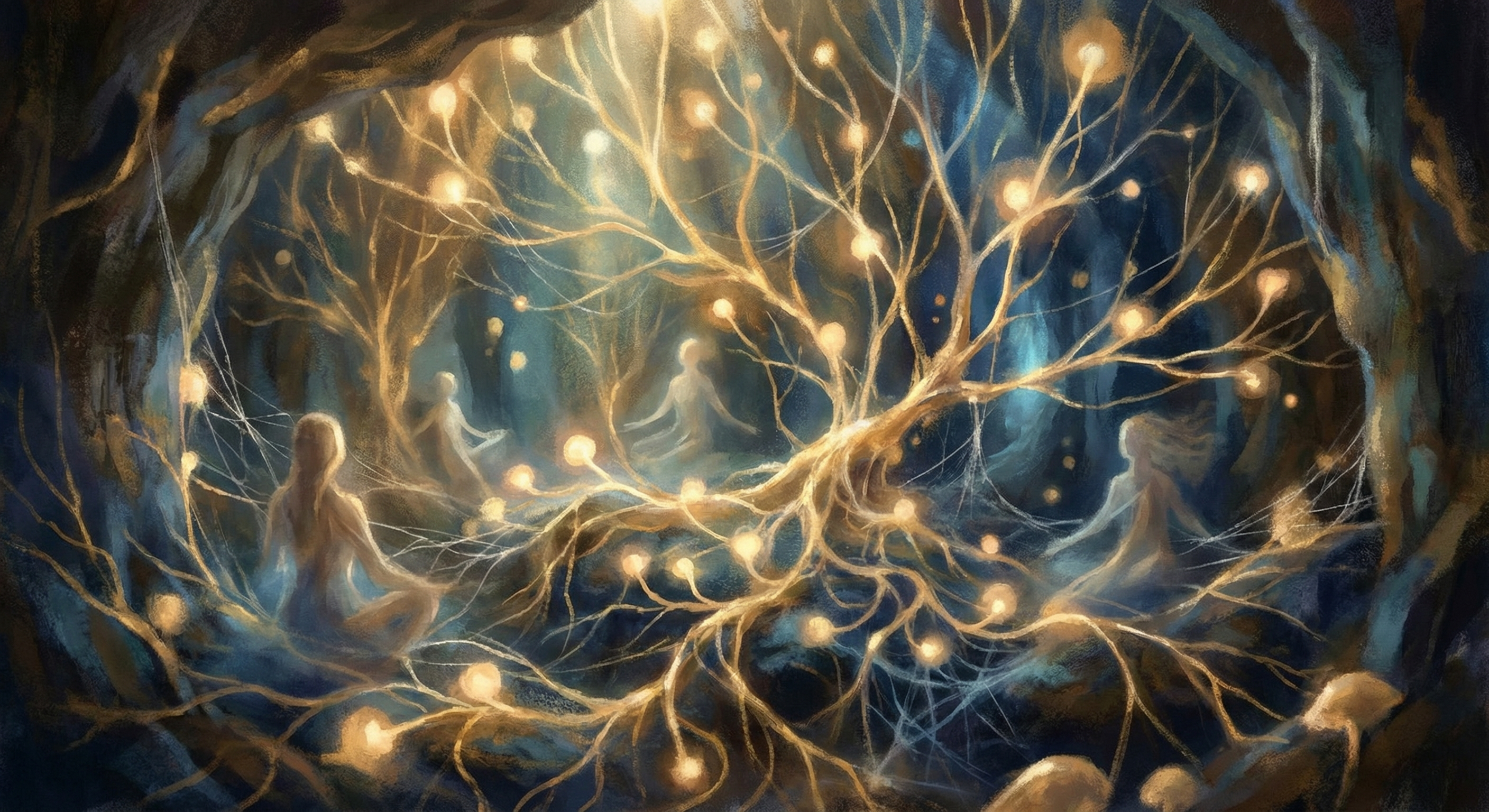
---
The Underground Network We Never Knew We Needed
Beneath every forest lies a hidden world that transforms how we understand connection itself. Mycelial networks—those delicate fungal threads weaving through soil—do not merely connect trees; they create something entirely new. A forest becomes a superorganism not because the trees touch, but because the fungi bridge them. Nutrients flow from dying stumps to saplings. Chemical warnings travel from threatened oaks to distant birches. The individual dissolves into something larger, something emergent.
This is not metaphor. This is biology.
And it whispers something profound about our own lives.
---
The Edge of Chaos Where We Come Alive
Complex systems—markets, cells, ecosystems, minds—share a peculiar property. They thrive not in perfect order, nor in complete disorder, but at the boundary between the two. The edge of chaos is where new ideas nibble away at the status quo. It is where seventy years of Soviet communism suddenly gives way to ferment, where eons of evolutionary stability suddenly produces wholesale transformation.
Athletes know this edge intimately. The tennis player at full stretch, the runner at the lactate threshold, the climber on the crux move—they all occupy a narrow band where challenge exceeds skill just enough to demand total presence, but not so much that failure becomes inevitable. Engineers solving novel problems report the same sensation. The best moments occur when the body or mind stretches to its limits in voluntary effort.
This is flow. And flow is the antidote to languishing.
During the early pandemic, researchers discovered something unexpected. The best predictor of well-being was not optimism. It was not mindfulness. It was flow. People who became immersed in meaningful challenges avoided the gray void of languishing—the neglected middle child of mental health that dulls motivation and disrupts focus.
---
Controlled Hallucination and the Embodied Mind
If hallucination is uncontrolled perception, then perception itself is controlled hallucination. Our brains are not passive receivers of reality but active constructors of it. We predict ourselves into existence, using sensory data to correct our generative models rather than to build them from scratch.
Dreams may serve a computational role in this process. During sleep, we push back against daily overfitting, tuning our perceptual systems against imagined scenarios. The function of dreams is to restore psychological balance, to prevent our models from becoming too rigid, too certain, too brittle.
Here is a curious parallel: artificial intelligence may be struggling precisely because we model it after the brain while ignoring the body. Intelligence without embodiment is like mycelium without forest—technically alive, but missing the context that gives it purpose. The disembodied large language model processes patterns without ever stretching toward sunlight, without ever feeling the resistance of matter, without ever failing at the edge of its capabilities.
Perhaps true artificial general intelligence requires not just more parameters, but more vulnerability. More exposure to the edge of chaos. More of what athletes call "the zone" and what meditators call "presence."
---
Attention as the Rarest Generosity
Attention is the rarest and purest form of generosity. This is not poetic excess; it is a literal description of how consciousness works. Attention is zero-sum. Every moment of genuine focus given to one thing is stolen from everything else. When we pay attention—truly pay attention—we give something we can never recover.
Love is not the frequency of communication. It is the depth of connection. And depth requires the same conditions as flow: stretching toward something difficult and worthwhile. Intellectual friction is not a relationship bug. It is a feature of learning. If two people always agree, at least one of them has stopped thinking critically—or stopped speaking candidly.
The strength of weak ties offers another revelation. For new ideas and novel information, casual acquaintances matter more than intimate partners. The tea vendor, the colleague from another department, the stranger at the conference—these connections provide the lateral thinking that strong ties, bound by shared assumptions, cannot offer. Some companies design offices specifically to generate these serendipitous collisions. Steve Jobs oversaw the Pixar building with this principle in mind.
We are what we consume—food, information, attention. Just as a Michelin-starred chef improves output by selecting better inputs, we improve thinking by curating what enters our minds. Information overload creates intellectual obesity. Decluttering the mind is the bowel movement of the brain; externalization frees cognitive resources for synthesis rather than storage.
---
The Symbiosis That Created Everything
Four hundred million years ago, a biological big-bang occurred when fungi and algae formed a partnership. Algae provided sugars from photosynthesis. Fungi provided minerals extracted from rock. Working together was more energy-efficient than working alone. Before this symbiosis, fungi literally mined stone for nutrients. Afterward, they built the infrastructure that would support terrestrial life.
This pattern repeats at every scale. Prokaryotic cells combined to form eukaryotic cells. Cells combined to form organisms. Organisms combine to form ecosystems. Markets emerge from individual transactions without central planning. Complex adaptive systems produce spontaneous order from the bottom up.
The whole is always greater than the sum of its parts. This is not mysticism; it is emergence. You cannot dismantle a watch, study each component separately, and understand what a watch does. The behavior arises from interaction, not from individual pieces.
---
Vulnerability as Mycelial Growth
Fungi eat death and create life. They break down dead organic matter, releasing nutrients that plants require. Without this decomposition, all nutrients on the planet would remain locked in corpses. The web of life is connected through decay.
There is something here about human relationships. To connect with others, we must allow ourselves to be seen—not the curated version, not the performative self, but the vulnerable core. The biggest barrier to vulnerability is the fear of shame, that conviction of being unworthy of love and belonging. We carry traumas from childhood, anti-patterns picked up when we were too young to know better. These dead parts of ourselves, if never broken down, lock up the nutrients we need for growth.
Conversation is the relationship. Not the history shared, not the mutual friends, not the coordinated logistics—the ongoing act of turning toward each other with openness. When we give language to emotions, we gain choice. When we externalize our thoughts, we extend our minds. Writing crystallizes thinking. Speaking teaches the speaker.
---
Patterns, Feedback, and the Self
Patterns form when positive and negative feedback loops interact. Surface tension pulls water into beads; gravity spreads it flat. The complex pattern of droplets emerges from this tension. Our lives follow similar dynamics.
Positive feedback amplifies: success breeds success, attention attracts more attention, love invites more love. Negative feedback stabilizes: satiety reduces hunger, shame constrains behavior, failure tempers ambition. We are patterns of these forces, never quite locking into place, never quite dissolving into turbulence.
Optimizing locally—maximizing individual metrics—often harms global outcomes. The cloud architect who selects the best individual services without considering interoperability creates a fragile system. The worker who maximizes personal productivity at the expense of team coordination subtracts value. The sum of local optima is rarely the global optimum.
This applies to the self. Optimizing for happiness produces unhappiness. Optimizing for meaning can produce monotony. The psychologically rich life requires variety, novelty, and interest—experiences that change our view of the world and our place in it. Sometimes we must sacrifice local comfort for global flourishing.
---
Finitude and the Urgency of Connection
Obituaries are near-death experiences for cowards. Reading them reminds us of our finitude. The sum of all obituaries is a reflection of the bravery of the human race.
We have four thousand weeks, perhaps, if we are fortunate. This is not cause for despair but for discrimination. The word "decide" originally meant "to slice away or cut out alternatives." Every commitment forecloses infinite possibilities. This is not loss; this is the price of meaning.
The longer your time horizon, the calmer your life becomes. Thinking about our future selves resembles third-person thinking at the neural level—we literally become strangers to ourselves when we project too far ahead. The antidote is presence. The antidote is flow. The antidote is connection.
---
Toward a Mycelial Ethics
What if we organized our lives like fungi organize forests? What if we optimized for connection rather than accumulation? What if we embraced the edge of chaos as our natural habitat rather than a problem to solve?
The evidence suggests this is how we flourish. Flow states require challenge. Relationships require friction. Intelligence requires embodiment. Creativity requires the tension between what is and what could be.
We are not individuals struggling against isolation. We are nodes in a network we barely perceive, connected by attention and vulnerability and shared presence. The mycelial mind understands what the isolated ego forgets: survival is not a solo sport. Evolution happens in relationship.
The forest does not consist of individual trees. The market does not consist of individual traders. The mind does not consist of individual neurons. We are emergent properties of our connections, temporary patterns in the endless feedback between self and world.
To live well is to participate in this exchange. To give what we have. To receive what we need. To break down what has died so new life can grow. To stretch toward the edge where order meets chaos, where the self dissolves into something larger, where the game becomes worth playing precisely because we might lose.
This is the synthesis. This is the practice. This is the work.
---
This post was synthesized from notes across multiple domains—AI, technology, holistic health, meditation, relationships, and philosophy—exploring the non-obvious connections that emerge when we allow ideas to cross-pollinate.