The Adversarial Self: What AI Training, Physical Limits, and Ancient Philosophy Reveal About Growth Through Opposition
Saturday, February 21, 2026
📥 Download Cover Image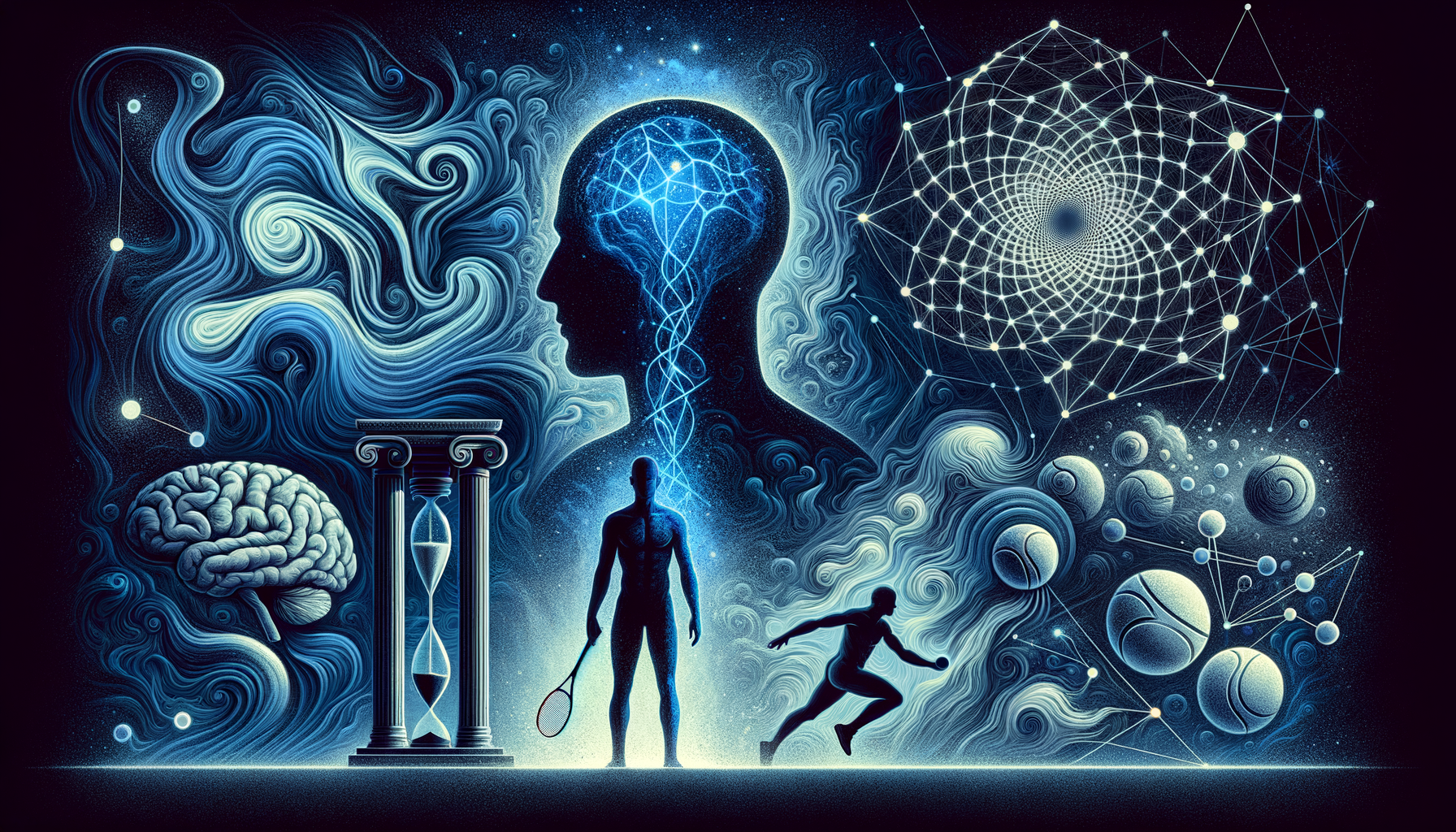
---
The Opponent You Cannot See
Every tennis player knows the moment. The score is tight. Your lungs burn. Your opponent has read your favorite shot three times in a row. You have a choice: retreat to what feels safe, or step into the discomfort of adaptation. Most players choose safety. The great ones choose growth.
Here is something peculiar: artificial intelligence learns the same way.
Modern machine learning systems do not improve through gentle guidance. They improve through adversity. Adversarial training deliberately feeds neural networks corrupted, deceptive, challenging inputs designed to make them fail. The system stumbles, adjusts its weights, and emerges more robust. Without this opposition, AI systems become brittle—capable on the surface, fragile beneath.
This is not a metaphor. It is the same mathematics applied to different substrates.
The tennis player facing a superior opponent and the neural network facing adversarial examples both occupy what researchers call the "edge of chaos"—that narrow band between too much order and too much disorder where learning happens fastest. Both require an external force that disrupts their current model of reality. Both must pay the cost of temporary failure to purchase permanent growth.
What neither the athlete nor the algorithm can do alone is choose this opposition voluntarily. That requires something neither possesses: philosophy.
---
The Stoic Alignment Problem
Artificial intelligence researchers speak of the "alignment problem"—how to ensure that increasingly powerful systems pursue goals compatible with human flourishing. The fear is that an AI optimizing for a poorly specified objective might destroy everything we value while technically succeeding at its assigned task.
But here is a blind spot: humans face the same alignment problem with ourselves.
We are prediction machines running on biological hardware, constantly optimizing for objectives that may not serve our deeper interests. The sugar craving that made sense for hunter-gatherers becomes metabolic debt in the modern world. The social anxiety that protected our ancestors from ostracism becomes isolation in cities of millions. The present bias that helped us survive immediate threats becomes procrastination when applied to long-term projects.
The Stoics understood this two thousand years ago. Epictetus taught that the dichotomy of control separates what is up to us—our judgments, our desires, our aversions—from what is not. Marcus Aurelius reminded himself daily that external events are not the problem; our interpretations are. Seneca warned that we suffer more in imagination than in reality.
This is alignment work. The Stoic practice of examining impressions before assenting to them is functionally identical to the AI safety practice of building reward models that reflect human values rather than easily gameable proxies. Both recognize that intelligence without proper objective functions produces pathological outcomes. Both seek to install a supervisory layer—philosophical reflection in humans, constitutional training in AI—that prevents the optimization process from running off the rails.
The modern AI researcher and the ancient philosopher converge on the same insight: intelligence requires opposition not just for learning, but for alignment. Without something pushing back, the optimizer optimizes itself into corners, into brittleness, into alienation from what matters.
---
Autophagy and Neural Pruning: The Wisdom of Strategic Destruction
Consider a peculiar parallel between two seemingly unrelated phenomena.
When you practice intermittent fasting, your cells enter a state called autophagy—literally "self-eating." Damaged proteins, dysfunctional mitochondria, cellular debris that would otherwise accumulate are identified, broken down, and recycled. The cell becomes cleaner, more efficient, more resilient. This is not starvation response. It is maintenance mode. The absence of constant nutrient influx triggers repair mechanisms that constant feeding suppresses.
Deep learning systems undergo a similar process. Neural network pruning removes weights—sometimes the majority of them—without degrading performance. The resulting sparse networks often generalize better, run faster, consume less energy. The mathematics of compression reveals that most parameters in a trained network are redundant or harmful. Strategic destruction creates better function.
Both processes violate our intuitions about growth. We assume that more is better, that accumulation equals progress, that maintenance is secondary to production. But complex systems—from cells to neural networks to economies—require periods of contraction, consolidation, and selective destruction to remain healthy. The forest that never burns accumulates fuel until it burns catastrophically. The codebase that never refactors becomes unmaintainable. The body that never fastes accumulates metabolic debt.
The Austrian economists called this "creative destruction"—the process by which old structures must dissolve for new ones to emerge. But the insight applies at every scale. Your brain prunes synaptic connections during sleep, keeping only what proved useful during wakefulness. Your gut microbiome turns over completely every few days, replacing itself through selective pressure. Your identity, if it is healthy, constantly sheds outdated self-conceptions to make room for growth.
The wisdom is ancient: you must die to yourself daily. The implementation is modern: fasting, pruning, compression, refactoring. The principle is universal: growth requires the courage to let go.
---
The Gut-Brain as Distributed Intelligence
Ninety percent of the neurons in your vagus nerve carry information from gut to brain, not the other way around. Your enteric nervous system contains five hundred million neurons—more than your spinal cord. The bacteria in your microbiome produce neurotransmitters, regulate inflammation, modulate mood, and influence decision-making. Scientists now speak of the "second brain" in your abdomen, a distributed processing system that handles information your conscious mind never accesses.
This is not merely biology. It is architecture.
Modern artificial intelligence is moving toward similar structures. Edge computing distributes processing across networks rather than centralizing it in massive data centers. Federated learning trains models across decentralized devices rather than aggregating data in one location. The recognition is growing that intelligence benefits from distribution—from pushing computation to where the data lives rather than bringing all data to where the computation lives.
Your gut-brain axis is the original edge computing system. It processes local information—nutritional content, microbial signals, immune markers—and sends only high-level summaries to the central processor. This is efficient. It is robust. It is why you can have a "gut feeling" about a decision before you can articulate why.
The implications for health are profound. Your microbiome is not a passive passenger but an active participant in your cognition. The foods you eat are not merely fuel but information that reshapes this distributed network. The fiber that feeds beneficial bacteria, the polyphenols that modulate inflammation, the fermented foods that introduce diversity—these are not wellness fads. They are maintenance protocols for your edge computing infrastructure.
But here is the deeper insight: your relationships function the same way.
The people you interact with regularly form a distributed network that processes information you cannot access alone. Your weak ties—acquaintances, colleagues, distant connections—serve the same function as your gut bacteria: they introduce diversity, challenge your assumptions, provide perspectives your strong ties cannot. The "strength of weak ties" that sociologists identified is structurally identical to the "wisdom of crowds" that emerges from distributed systems. Both rely on independence, diversity, and aggregation mechanisms that preserve useful signal while filtering noise.
To be healthy is to maintain this distributed intelligence at every level: cellular, microbial, social. Isolation is the disease of networks. Whether it is an impoverished microbiome, a pruned neural network with no residual connections, or a person cut off from weak-tie relationships, the pattern is the same: too little diversity, too much centralization, fragility disguised as efficiency.
---
Lactate Thresholds and Cognitive Plasticity
There is a moment in endurance exercise when your muscles produce lactate faster than they can clear it. The burning sensation intensifies. Your pace must slow, or you will crash. This is your lactate threshold—the boundary between sustainable effort and unsustainable accumulation.
Elite athletes train specifically at this threshold, deliberately approaching the edge where the system begins to fail. The adaptation is not just muscular. It is metabolic, cardiovascular, neurological. The body learns to buffer acid, transport oxygen, recruit motor units more efficiently. The threshold itself shifts upward, expanding the range of sustainable effort.
Remarkably, the same process occurs in the brain.
Recent research reveals that lactate is not merely a metabolic waste product but a signaling molecule that promotes brain-derived neurotrophic factor, enhances synaptic plasticity, and supports myelination. The metabolic stress of exercise triggers cognitive adaptations. The threshold where your body begins to struggle is also where your brain begins to grow.
This is the edge of chaos again, now viewed through metabolic lenses. Too little challenge, and no adaptation occurs. Too much, and the system breaks. The sweet spot—the lactate threshold, the flow channel, the gradient descent step size—is where growth happens fastest.
The parallel to learning is exact. Cognitive psychologist Anders Ericsson found that expert performance emerges from "deliberate practice"—focused effort at the edge of current ability, with immediate feedback and gradual progression. The discomfort of not knowing, of failing, of stretching beyond current capacity—is not an unfortunate side effect of learning. It is the mechanism. Just as lactate signals metabolic adaptation, confusion signals neural adaptation.
Modern AI systems replicate this through curriculum learning—starting with easy examples and gradually increasing difficulty. The learning rate, perhaps the most important hyperparameter in training, determines how far the system moves in response to each error. Too large, and training becomes unstable. Too small, and learning takes forever. The art of machine learning is finding the threshold where the system learns fastest without collapsing.
You are a learning system. Your lactate threshold is not a limitation to avoid but a frontier to explore. Your confusion is not a signal to retreat but an invitation to grow. The burning sensation—physical, cognitive, emotional—is feedback that you are at the edge where adaptation occurs.
---
Attention Mechanisms: Focus as Information Routing
The transformer architecture revolutionized artificial intelligence by introducing a mechanism called "attention." Rather than processing information sequentially, transformers learn which parts of the input to focus on when producing each part of the output. The model learns to route information dynamically, attending to what matters and ignoring what does not.
Your brain implements a similar mechanism. The neural networks of attention—alerting, orienting, and executive—select which stimuli merit processing from the constant flood of sensory input. Without this filtering, you would be overwhelmed. With it, you can focus on a conversation in a noisy room, track a tennis ball among distractions, or maintain concentration on a difficult problem.
Meditation is attention training. The practice of returning attention to a chosen object—breath, mantra, sensation—strengthens the same neural circuits that the transformer learns to use. Neuroimaging studies show that experienced meditators exhibit enhanced attentional control, reduced default mode network activity, and improved ability to disengage from distracting stimuli.
But here is the deeper connection: both attention mechanisms face the same fundamental constraint. Attention is zero-sum. You cannot attend to everything. Every allocation is a choice with opportunity costs. The transformer that attends to one part of the input necessarily attends less to others. The human who focuses on one task necessarily neglects others.
This creates an economics of attention. The Austrian insight about time preference—the tendency to discount future rewards relative to present ones—applies directly. Immediate distractions offer small present rewards. Sustained focus offers large future rewards. The attention mechanism that succumbs to present bias is the same as the economic agent with high time preference: both underweight the future, both accumulate debt, both face eventual crisis.
The solution in both domains is similar: create structures that reduce the cost of good choices. For AI, this means architectural choices that make attention routing easier to learn. For humans, it means environmental design that removes distractions, commitment devices that bind future action, and practices like meditation that strengthen attentional control.
Your attention is the rarest resource you possess. It is also the most expensive thing you give away. Every scroll, every notification, every context switch is a withdrawal from a finite account. The attention mechanism you are training—whether through meditation, through deep work, or through the discipline of presence—determines what you can know, what you can create, who you can become.
---
Graph Networks of Relationship
Graph neural networks represent relationships as nodes connected by edges, learning to propagate information across this structure to make predictions about entities or the network as a whole. Social network analysis uses the same mathematics to understand how information flows through human relationships, how influence spreads, how communities form and dissolve.
Your relationships form a graph. You are a node. Your connections are edges, weighted by frequency, intimacy, and reciprocity. The structure of this graph determines what information reaches you, what opportunities you encounter, what perspectives shape your thinking.
Strong ties—close friends, family, intimate partners—form dense clusters where information circulates quickly but redundantly. Everyone knows what everyone else knows. Weak ties—acquaintances, colleagues, distant connections—bridge between clusters, carrying novel information that has not yet saturated your immediate circle. The sociologist Mark Granovetter found that weak ties matter more than strong ties for finding new opportunities precisely because they connect you to different information ecosystems.
This is graph theory made personal. Your weak ties are your graph's bridges, the edges whose removal would most increase the average path length between nodes. They are also, paradoxically, the edges most likely to decay from disuse. Strong ties maintain themselves through frequent interaction. Weak ties require deliberate cultivation or they dissolve.
The implication is clear: if you want to increase your surface area for luck, invest in weak ties. The casual coffee, the conference conversation, the reconnection with a former colleague—these are not distractions from productive work. They are graph-theoretic operations that expand your reach into possibility space. The person who introduces you to your next opportunity is probably not your closest friend. They are a weak tie, a bridge to a different cluster, a carrier of information your strong ties cannot provide.
But here is the blind spot: we optimize for strong ties because they feel good. Deep intimacy satisfies a genuine human need. But exclusive focus on strong ties collapses your graph into isolated clusters, each rich in redundant information but poor in novelty. The healthy social graph maintains both: dense cores of strong ties for support, and extensive weak-tie bridges for opportunity.
Your social network is not merely a source of companionship. It is a distributed learning system, an information filter, a prediction market where diverse perspectives aggregate into insights no individual could generate. To neglect its structure is to accept the default graph that circumstance produces rather than designing one that serves your flourishing.
---
The Synthesis: Opposition as the Engine of Growth
These threads converge on a single insight: growth requires opposition. The tennis player improves through challenging opponents. The neural network learns through adversarial examples. The cell maintains health through autophagy triggered by nutrient absence. The brain builds resilience through metabolic stress. The attention mechanism focuses by filtering distraction. The social network provides novelty through weak-tie bridges.
This is not masochism. It is the structure of complex adaptive systems. Without opposition, systems atrophy. Muscles weaken without resistance. Minds narrow without challenge. Relationships stagnate without friction. Civilizations decline without external pressure.
The Stoic embrace of difficulty, the athlete's pursuit of the lactate threshold, the AI researcher's use of adversarial training, the meditator's confrontation with distraction—all are expressions of the same principle. Opposition is not obstacle. It is information. It is the signal that tells the system where its model of reality diverges from reality itself. It is the feedback that enables adaptation.
Your task is to seek this opposition deliberately. To practice at your lactate threshold, where the burn signals growth. To engage with perspectives that challenge your own, where the discomfort signals learning. To fast periodically, where the hunger signals cellular repair. To meditate, where the wandering mind signals the opportunity to strengthen attention. To maintain weak ties, where the awkwardness of reaching out signals expanded possibility.
The adversarial self is not the self under attack. It is the self that has learned to use opposition as fuel. The self that understands that comfort is not the goal. The self that has aligned its optimization process with what actually produces flourishing.
This is the synthesis of AI and athletics, of philosophy and physiology, of ancient wisdom and modern science. The edge of chaos is not a place of danger. It is the only place where learning happens. The opponent is not an enemy. They are the necessary condition for your growth.
Step onto the court. The game is waiting.
---
Generated: February 21, 2026
Connections synthesized across artificial intelligence, tennis and athletic training, Stoic philosophy, metabolic health, meditation practice, social network theory, and complex systems thinking.